
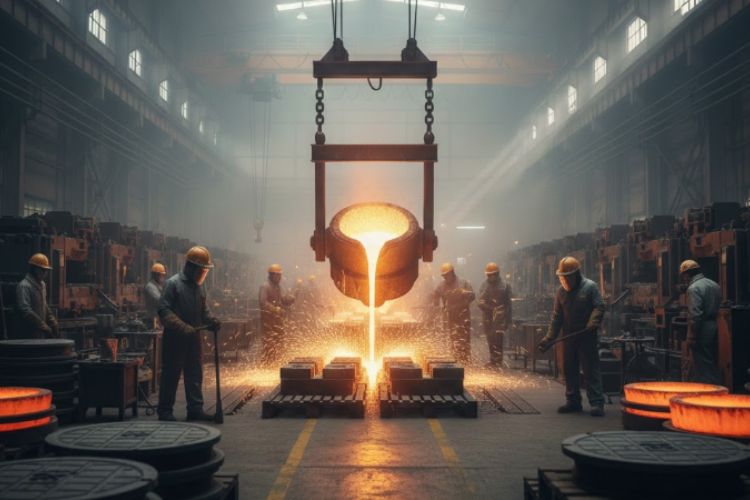

What makes a casting truly “export-quality”? Is it the shine of the finished surface, the tensile strength, or the ability to pass international inspection without a second thought? In today’s competitive global market, export-grade cast iron castings from India are not just about manufacturing—they’re about precision, compliance, and long-term performance.
Over the past two decades, the reputation of the modern Cast Iron Foundry India has evolved dramatically. Indian foundries now supply components to infrastructure projects, automotive OEMs, and utility sectors worldwide. And they’re doing so while meeting global benchmarks for quality and durability.
Also Read: Why Modern Vehicles Still Depend on Proven Metal Engineering
Why India Has Become a Casting Export Powerhouse
India consistently ranks among the top casting producers globally. According to the World Foundry Organization, India is one of the leading cast metal producers, contributing significantly to global output. But volume alone doesn’t define export quality—standards do.
Export-quality cast iron castings are typically manufactured under strict ISO certifications, with chemical composition controls, metallurgical testing, and third-party inspections. Many Indian manufacturers also comply with ASTM and EN standards, ensuring compatibility with European and North American markets.
Key Factors That Define Export-Quality Castings
- Material Consistency: Precise control of carbon and silicon content for predictable strength.
- Dimensional Accuracy: Advanced molding and machining processes reduce tolerance deviations.
- Surface Finish: Shot blasting and coating treatments enhance corrosion resistance.
These are not optional extras—they are expectations from international buyers.
Applications Driving Global Demand
Export-grade castings from India support industries where failure simply isn’t acceptable. Think urban drainage systems, heavy engineering equipment, railway components, and municipal infrastructure.
For instance, products like the Recessed Manhole Cover are widely exported for city development projects. These covers are designed to bear significant loads while maintaining aesthetic integration with pavements—something European infrastructure planners often prioritize.
Similarly, specialized Agricultural Castings play a crucial role in farming equipment exported to Africa and Southeast Asia. Durability in harsh conditions—dust, moisture, fluctuating temperatures—is critical, and Indian foundries are engineering products specifically for those environments.
Technology and Testing: The Backbone of Quality
Let’s be honest—traditional sand casting alone no longer satisfies global buyers. Export markets demand technology-backed assurance. Leading manufacturers now integrate:
- Spectrometer analysis for accurate chemical composition checks.
- Non-destructive testing (NDT) to detect internal flaws.
- CNC machining for high-precision finishing.
The National Institute of Standards and Technology (NIST) emphasizes that quality control systems significantly improve manufacturing reliability and reduce defect rates. Indian exporters increasingly align with such internationally recognized practices to build trust abroad.
Cost Efficiency Without Compromising Standards
One of India’s biggest advantages is its ability to combine cost-effectiveness with compliance. Competitive labor costs, strong domestic raw material supply, and established port infrastructure make exporting viable without sacrificing quality.
But here’s the nuance—cheap does not mean inferior. The best export-oriented foundries invest heavily in training, automation, and environmental compliance. Many are adopting sustainable casting processes, including improved energy efficiency and waste sand recycling, aligning with global ESG expectations.
What International Buyers Look For
- ISO 9001 or equivalent quality certification
- Proven export track record
- Transparent inspection reports
Trust, in this business, is built batch by batch.
Frequently Asked Questions
What makes cast iron castings export-quality?
Export-quality castings meet international material standards, undergo rigorous testing, and maintain precise dimensional tolerances suitable for global markets.
Are Indian cast iron castings accepted in Europe and the USA?
Yes. Many Indian manufacturers comply with ASTM and EN standards, allowing seamless acceptance in European and North American markets.
How do manufacturers ensure durability?
Through controlled metallurgy, non-destructive testing, load testing, and corrosion-resistant coatings that extend product lifespan.
Can customized castings be exported?
Absolutely. Many foundries specialize in tailor-made solutions designed according to client drawings and application requirements.
Also Read: Top Cast Iron Foundries Leading Manufacturing in India
Final Thoughts
Export-quality cast iron castings from India represent more than industrial output—they symbolize reliability, engineering maturity, and global trust. With advanced testing, international certifications, and application-specific innovation, Indian foundries continue to shape infrastructure projects far beyond domestic borders.
Blog Development Credits:
This article was ideated by Bengal Iron Corporation, drafted with the support of AI-powered research tools, and meticulously refined and optimized by the experienced team at Bengal Iron Corporation.