
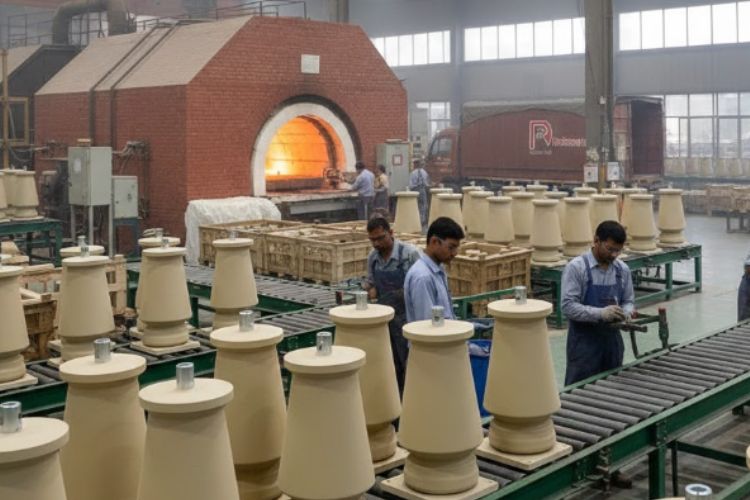

In heavy industries, reliability is rarely loud, but its absence is always obvious. One small failure can halt an entire system, especially in high-voltage environments. That’s why choosing the right shaft insulator manufacturer matters more than many engineers initially realize. When performance, safety, and long-term efficiency are at stake, trust isn’t optional—it’s essential.
India has steadily built a reputation for precision ceramics and electrical components, and today, working with a Shaft Insulators Supplier in India often means accessing decades of material expertise, process discipline, and real-world industrial insight under one roof.
Also Read: How Insulators Support Reliable Power Transmission in Factories
Why Shaft Insulators Are Mission-Critical
Shaft insulators play a quiet but crucial role in systems like electrostatic precipitators (ESPs), turbines, and rotating electrical assemblies. Their job is deceptively simple: electrically isolate moving shafts while tolerating heat, vibration, dust, and mechanical stress.
In practice, this balance is hard to achieve. A minor flaw in composition or firing can lead to cracks, leakage currents, or sudden breakdowns. According to industrial safety data published by the U.S. Department of Energy, insulation failure remains one of the leading contributors to unplanned downtime in high-voltage equipment—often due to material degradation rather than design errors.
What Defines a Trusted Manufacturer?
Not all manufacturers are built the same. Trust, in this space, isn’t about marketing language—it’s earned on the factory floor.
Key characteristics engineers look for:
- Material integrity: High-purity porcelain or advanced ceramic blends that resist thermal shock and electrical stress.
- Process control: Consistent firing temperatures, dimensional accuracy, and repeatable quality checks.
- Application knowledge: Understanding how insulators behave inside ESP chambers, not just on paper.
Many Indian manufacturers have evolved beyond basic production, integrating testing labs and feedback loops from power plants, cement factories, and steel units.
India’s Growing Leadership in Industrial Insulation
Over the last two decades, India’s ceramics and electrical insulation sector has matured significantly. This isn’t accidental. Investments in kiln technology, raw material sourcing, and export-grade quality systems have raised the bar.
It’s no surprise that global EPC contractors now regularly shortlist Electrical Insulator Manufacturers in India for both domestic and international projects. Many of these manufacturers align with ISO standards and follow testing protocols similar to those outlined by organizations like IEA and NREL, particularly for power and emission-control systems.
Real-World Benefits of Choosing the Right Supplier
From an operational standpoint, the right shaft insulator supplier delivers value well beyond the component itself.
- Longer service life: Reduced micro-fractures and better glaze stability mean fewer replacements.
- Lower maintenance costs: Consistent insulation minimizes unexpected shutdowns.
- Better system efficiency: Stable electrical isolation improves overall ESP and motor performance.
Engineers often say that a good insulator goes unnoticed for years—and that’s the highest compliment it can receive.
Customization and Industry-Specific Solutions
One overlooked advantage of experienced Indian manufacturers is customization. Shaft insulators aren’t always off-the-shelf items. Variations in shaft diameter, voltage load, and ambient temperature demand tailored solutions.
Trusted suppliers collaborate closely with OEMs and plant engineers, adjusting profiles, creepage distances, and material formulations. This flexibility is especially valuable in cement plants, thermal power stations, and pollution-control retrofits where legacy equipment is common.
Frequently Asked Questions
What industries commonly use shaft insulators?
Shaft insulators are widely used in electrostatic precipitators, power generation units, cement plants, steel factories, and other high-voltage rotating systems.
How do I assess the quality of a shaft insulator?
Look for material purity, test certifications, dimensional accuracy, and the manufacturer’s experience with similar industrial applications.
Are Indian shaft insulators suitable for export projects?
Yes. Many Indian manufacturers supply to international markets and follow globally accepted quality and testing standards.
Can shaft insulators be customized?
Absolutely. Reputed manufacturers offer customization based on voltage, shaft size, temperature range, and operating conditions.
Also Read: How Indian Insulator Makers Are Powering Global Demand
Final Thoughts
In industrial systems, trust is built component by component. Choosing a reliable shaft insulator manufacturer in India isn’t just a procurement decision—it’s a long-term investment in safety, uptime, and peace of mind.
Blog Development Credits
This article was thoughtfully developed by Reliance Potteries, refined with modern AI-assisted research tools, and carefully optimized with practical SEO insights by the Reliance Potteries team.